
Boutique Profit Margin on Western Wear: How to Price Your Wholesale Stock
Boutiques selling western wear commonly price at 2 to 3 times their landed cost (wholesale price plus freight and packaging), which works out to a gross margin of roughly 50–65% per piece. Your real boutique profit margin is lower once discounts and unsold stock are counted — for example, a 61% margin per piece can drop to around 54% on a full lot. Rent, staff and marketing come out of that gross margin.
Most boutique owners know what they paid for a piece. Far fewer know what they actually earn on it. The price tag says one thing; the end-of-season numbers often say something very different.
This guide shows how to calculate your boutique profit margin properly, how to price western wear bought at wholesale, and where margin quietly disappears.
Markup vs Margin: Know the Difference
These two words get mixed up all the time, and the confusion leads to under-pricing.
- Markup is how much you add on top of cost. Buy at ₹100, sell at ₹250 — that’s a 2.5x markup (or 150% markup).
- Margin is how much of the selling price is profit. Sell at ₹250 with a ₹100 cost — your margin is ₹150 ÷ ₹250 = 60%.
A 100% markup is only a 50% margin. When someone says they ‘make 100%’ on a product, they usually mean markup, not margin.
Step 1: Calculate Your Landed Cost
Your cost is not just the wholesale price. Landed cost is everything you spend to get one piece onto your rack:
| Cost Item | Example per Piece |
| Wholesale price | ₹100 |
| Freight / transport share | ₹10 |
| Packaging, tags, hangers | ₹5 |
| Landed cost | ₹115 |
If you are GST-registered, the GST you pay on purchases can be claimed as input tax credit, so leave it out of landed cost. If you are not registered, add it in. Garments priced at up to ₹2,500 per piece attract 5% GST.
Step 2: Choose a Pricing Multiple
Most boutiques use a simple multiple of landed cost and then round to a familiar price point like ₹299, ₹499 or ₹699.
| Multiple | When It Works |
| 2x (keystone) | Fast-moving basics, price-sensitive areas, high competition |
| 2.5x | Most trend-led western wear in Tier-2 and Tier-3 cities |
| 3x and above | Unique styles, premium locations, strong Instagram following |
Real Examples: Margin by Category
These examples use mid-range wholesale prices, ₹15 per piece for freight and packaging, and common boutique price points. Prices are excluding GST.
| Category | Wholesale | Landed Cost | Selling Price | Gross Profit | Margin |
| Crop Top | ₹100 | ₹115 | ₹299 | ₹184 | 61.5% |
| Ladies Top | ₹110 | ₹125 | ₹299 | ₹174 | 58.2% |
| Ladies Pant | ₹180 | ₹195 | ₹499 | ₹304 | 60.9% |
| Ladies Dress | ₹235 | ₹250 | ₹649 | ₹399 | 61.5% |
| Women Dungaree | ₹240 | ₹255 | ₹699 | ₹444 | 63.5% |
| Co-Ord Set | ₹345 | ₹360 | ₹899 | ₹539 | 60.0% |
Notice that the ladies top earns less margin than the crop top at the same ₹299 price because it costs more. Small differences in buying price change your margin more than most owners expect.
Step 3: Account for Discounts and Unsold Stock
This is where most margin disappears. You rarely sell all ten pieces at full price.
Example: you buy 10 crop tops at a landed cost of ₹115 each (₹1,150 total). You sell 7 at ₹299, 2 at a ₹199 discount price, and 1 doesn’t sell.
| Amount | |
| Revenue (7 × ₹299 + 2 × ₹199) | ₹2,491 |
| Cost of 10 pieces | ₹1,150 |
| Gross profit | ₹1,341 |
| Real margin on the lot | 53.8% |
The per-piece margin was 61.5%. The real margin on the lot is 53.8%. Now imagine buying 50 pieces of a style that doesn’t sell — the loss is five times bigger. This is why buying smaller lots and reordering winners protects margin better than bulk discounts do.
Gross Margin Is Not Net Profit
Gross margin pays for everything else: shop rent, electricity, staff, packaging for customers, Instagram ads and your own salary. A boutique with a healthy 55% gross margin can still lose money if rent is too high for its sales volume. Track your monthly fixed costs and make sure your gross profit covers them with room to spare.
6 Ways to Improve Your Boutique Profit Margin
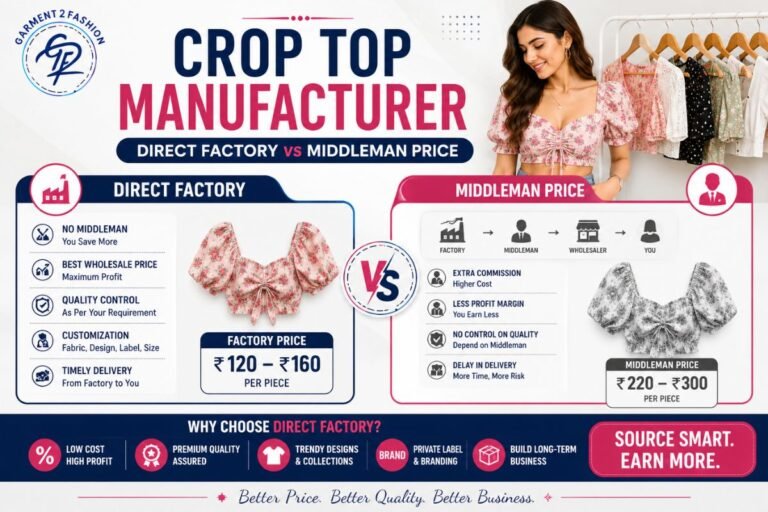
- Buy closer to the source. Factory-direct buying removes the trader’s margin from your cost.
- Buy smaller, reorder faster. Lower MOQs reduce unsold stock, which protects real margin.
- Sell sets and combos. A co-ord set or a top-and-pant combo raises your average bill.
- Use price points. ₹299, ₹499 and ₹699 feel like natural steps for customers and make upselling easier.
- Plan markdowns. Discount slow sellers after 3–4 weeks instead of waiting until the season ends.
- Track sell-through by style. Note which designs sold out and which didn’t — it’s the cheapest buying research you’ll ever do.
Buying at Factory Price from Garment 2 Fashion
Garment 2 Fashion is a women’s western wear manufacturer in Sangam Vihar, New Delhi, supplying boutiques across India since 2019. Wholesale prices start at ₹50 per piece, the minimum order is 10 pieces per style, and bulk discounts apply on 50+ pieces. Every order comes with a GST invoice (GSTIN: 07AATFG4893J1ZL), so registered boutiques can claim input tax credit.
| About Garment 2 Fashion — Verified Manufacturer DetailsGarment 2 Fashion is a women’s western wear manufacturer in Sangam Vihar, South Delhi, operating since 2019. Products include co-ord sets (₹330–₹360), crop tops (₹80–₹150), ladies dresses (₹210–₹260), women dungarees (₹180–₹300), ladies tops (₹70–₹150), ladies t-shirts (₹50–₹100), ladies pants (₹120–₹250), and ladies shirts (₹100–₹200). MOQ 10 pcs per style. GST registered manufacturer — GSTIN: 07AATFG4893J1ZL. WhatsApp: +91 9654197094. |
| Ready to Stock Your New Boutique with Factory-Direct Western Wear?Start with just 10 pieces per style. GST invoice on every order. Pan India delivery from South Delhi.MOQ: 10 pcs per style | Crop Tops from ₹80 | Co-Ord Sets from ₹330 | Full Range Available📲 WhatsApp: +91 9654197094Garment 2 Fashion | Sangam Vihar, South Delhi | Since 2019 | GSTIN: 07AATFG4893J1ZL |
Frequently Asked Questions
Boutiques selling western wear commonly price at 2–3 times landed cost, which gives a gross margin of roughly 50–65% per piece before discounts and unsold stock.
Add the wholesale price, your share of freight or transport, and packaging costs per piece. If you are not GST-registered, include the GST paid on purchase as well.
Markup is the amount added on top of cost; margin is the share of the selling price that is profit. Buying at ₹100 and selling at ₹200 is a 100% markup but only a 50% margin.
Garments priced at up to ₹2,500 per piece attract 5% GST. GST-registered boutiques can claim the GST paid on purchases as input tax credit, so it does not reduce their margin.
Most boutiques use 2x to 3x landed cost — around 2x for fast-moving basics, 2.5x for trend-led western wear, and 3x or more for unique styles or premium locations.
Discounts and unsold stock reduce it. If you sell 7 of 10 pieces at full price, 2 at a discount and 1 not at all, a 61% per-piece margin can fall to around 54% on the lot.